NVIDIA’s Isaac GR00T Model: Teaching Humanoid Robots to Reason and Learn
Published on: 2025-09-29 • Category: Robotics • By Timeless Quantity
Key Takeaway: NVIDIA has unveiled Isaac GR00T — an open-source foundation model designed to give humanoid and mobile robots a deeper capacity for reasoning, task understanding, and embodied learning. Combined with new simulation libraries, GR00T could transform how physical AI learns to perceive and interact with the real world.

From Graphics to General Robotics
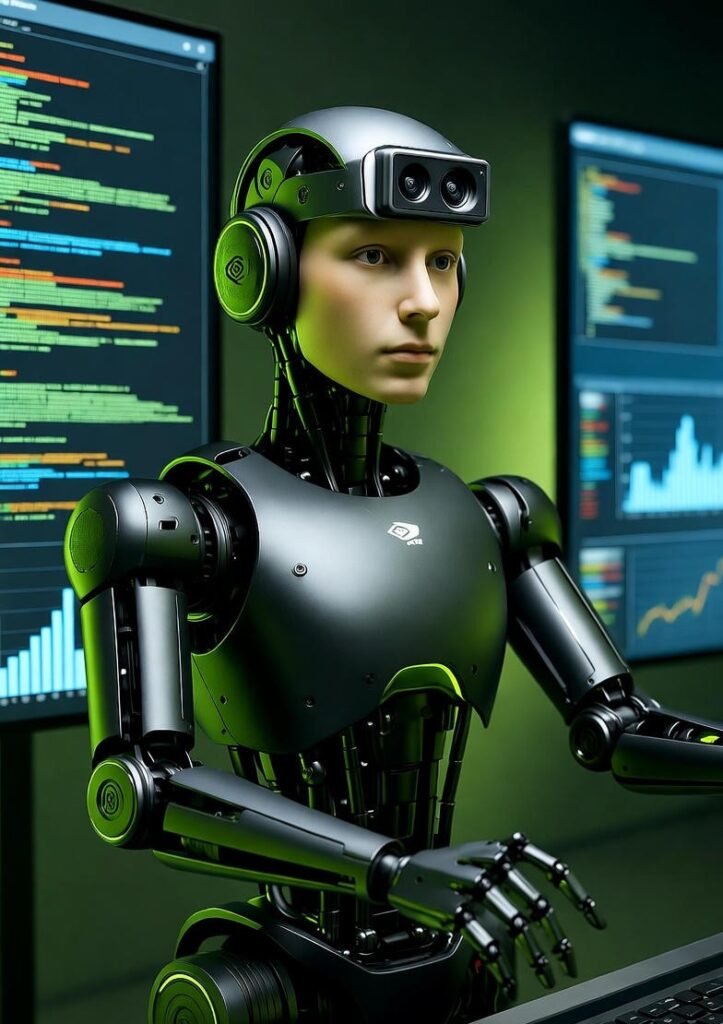
For decades, NVIDIA has fueled visual computing and AI acceleration. With Isaac GR00T, it’s extending that mission into the physical domain: building the “GPT moment” for robotics. Instead of text, GR00T’s training corpus consists of trajectories, sensor data, 3D environments, and multimodal demonstrations. The goal is simple — teach machines to learn by seeing, moving, and repeating like humans do.
The model underpins NVIDIA’s broader Project GR00T initiative — “General Robot 00 Training.” Its debut comes as demand surges for general-purpose robots capable of performing tasks that can’t be hard-coded in advance.
Architecture and Learning Pipeline
GR00T sits at the intersection of foundation models and robot simulation. Key components include:
- Multimodal Encoder: Processes RGB-D frames, IMU signals, and language commands to create a shared latent space for action prediction.
- Action Decoder: Generates continuous motor commands or policy parameters for different robot morphologies.
- Simulation Feedback Loop: Integrates NVIDIA Omniverse and Isaac Sim for billions of synthetic interactions each week, accelerating pre-training.
- Cross-Robot Transfer: Policies trained in simulation can adapt to real-world hardware through domain randomization and online reinforcement learning.
The result is a system that learns skills, not scripts — grasping objects, walking, balancing, and even planning multi-step tasks from language instructions.
The Isaac Ecosystem Evolves
GR00T is part of the expanding Isaac ecosystem, which now includes simulation frameworks, digital-twin tools, and edge deployments on Jetson and Orin platforms. Through tight integration with CUDA and TensorRT, robot developers can train and run models using the same GPUs that power deep-learning workloads.
This unification bridges a critical gap: simulation data feeds AI training directly, and trained models feed back into simulation for continuous improvement. The loop reduces hardware wear, speeds iteration, and lowers the barrier for researchers building safe and capable embodied AI.
Applications and Industry Impact
Potential uses for GR00T extend well beyond lab robots. Industries are eyeing applications in:
- Manufacturing: Adaptive assembly lines where robots reconfigure to new products without reprogramming.
- Logistics and Warehousing: Cooperative robots that learn to navigate dynamic spaces and handle unfamiliar items.
- Healthcare Assistance: Safe mobility aids that interpret spoken commands and adjust to patients’ needs.
- Space and Hazardous Environments: Teleoperation with autonomous fallback for missions too dangerous for humans.
By releasing GR00T as an open model, NVIDIA hopes to spark a community similar to PyTorch or Hugging Face — where shared datasets and policies accelerate the entire field.
Competition and Collaboration
Other players — OpenAI, Boston Dynamics AI Institute, and DeepMind — are pursuing similar “embodied intelligence” projects. Yet NVIDIA holds a unique advantage: it owns the hardware stack, simulation engine, and AI toolchain end-to-end. That means GR00T can evolve in lockstep with new GPU architectures and physics rendering tech, compressing the R&D cycle for robotic learning.
Expect a wave of partnerships between hardware manufacturers and NVIDIA’s Isaac team to embed GR00T policies into commercial humanoids and mobile robots over the next 18 months.
What’s Next for Embodied AI
The bigger story is that foundation models are leaving the screen. Just as LLMs transformed language, GR00T-like systems could transform action — making robots capable of reasoning and executing in open environments. Future milestones to watch include:
- Cross-domain transfer — robots learning new tasks from video or text prompts.
- Integration with agentic AI frameworks for autonomous planning and scheduling.
- Community benchmarks for safety, sample efficiency, and zero-shot adaptation.
As hardware catches up with simulation, expect humanoids to graduate from demo rooms to factory floors and eventually public spaces — a future where physical AI is as ubiquitous as cloud software today.
The Bottom Line
NVIDIA’s Isaac GR00T marks a turning point in robotics. By merging simulation, AI training, and hardware acceleration, it provides a template for teaching machines to think and act in the real world. As developers begin building on this foundation, the gap between digital intelligence and embodied capability will shrink fast — reshaping manufacturing, mobility, and everyday work within this decade.
About Timeless Quantity: Your daily lens on AI, space, and the digital future. Subscribe for deep dives and insightful explainers.