NASA Artemis II Prep: Stacking Toward Humanity’s Next Moon Orbit Mission
Published on: 2025-10-01 • Category: Space • By Timeless Quantity
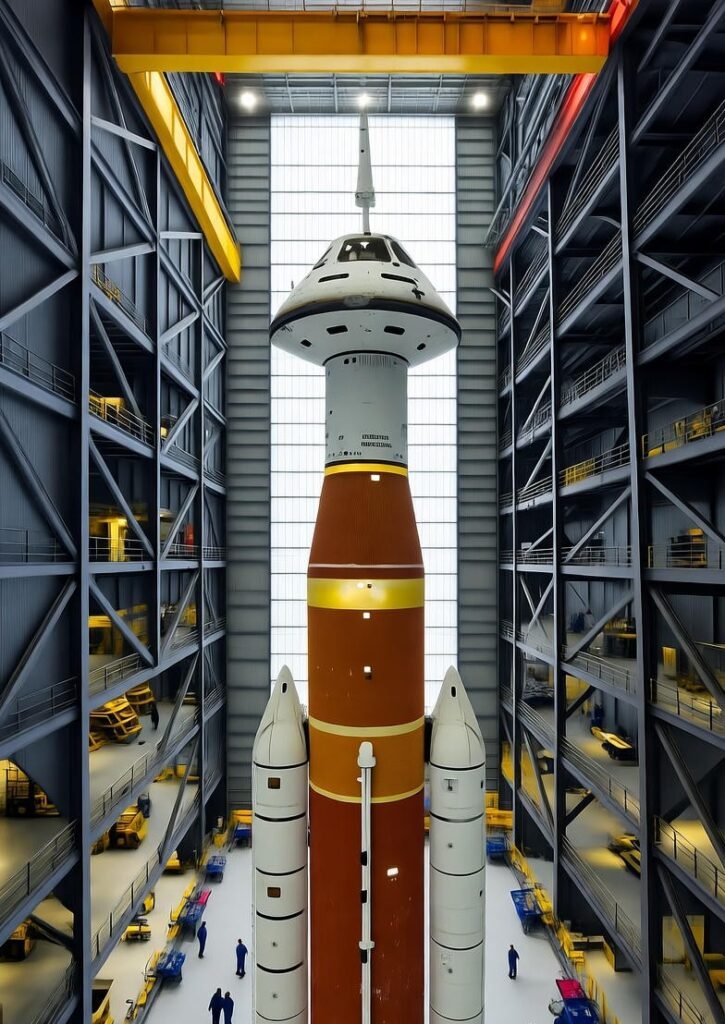
Key Takeaway: NASA has completed the stacking of its Space Launch System (SLS) rocket and Orion spacecraft inside the Vehicle Assembly Building at Kennedy Space Center. This marks the most visible step yet toward Artemis II, the first crewed mission to the Moon’s vicinity since Apollo 17 in 1972. With systems integration under way and crew training intensifying, NASA is preparing for a 2026 launch that will validate every critical element for returning humans to the lunar surface.
From Apollo Legacy to Artemis Ambition
Artemis II is the second flight in NASA’s multi-mission program to establish a sustained presence on and around the Moon. Where Artemis I proved the uncrewed SLS and Orion could operate safely in deep space, Artemis II will carry four astronauts on a ten-day lunar orbit journey. The mission’s goals: demonstrate life-support systems, evaluate crew operations in deep-space radiation, and perform a high-speed re-entry from lunar velocity — the final hurdle before landing missions resume with Artemis III.
Hardware Integration and Stacking
The core stage, built at NASA’s Michoud Assembly Facility and powered by four RS-25 engines from the Space Shuttle era, has been mated with two five-segment solid rocket boosters. Above that sits the Interim Cryogenic Propulsion Stage (ICPS) and the Orion capsule with its European-built service module. Stacking is as symbolic as it is technical — the first time since Apollo the U.S. has assembled a complete crew-rated Moon rocket.
Teams are now running interface verifications, electrical connectivity checks, and hydraulic tests while installing flight instrumentation for data monitoring during ascent and coast phases.
The Crew and Their Training
The Artemis II crew includes Reid Wiseman (Commander), Victor Glover (Pilot), Christina Hammock Koch (Mission Specialist I), and Jeremy Hansen (CSA, Mission Specialist II) — the first diverse, international team to travel beyond Earth orbit. Training has moved from simulation labs to hardware-integrated sessions with mock-ups of Orion’s cockpit and emergency scenarios replicating deep-space contingencies.
Each crew member is certified for manual attitude control of Orion, life-support maintenance, and high-G re-entry procedures. Parallel training with ESA teams ensures cross-compatibility with European Service Module operations.
Mission Profile and Objectives
- Duration: ~10 days round trip.
- Trajectory: A hybrid free-return orbit around the Moon (~10,000 km altitude) to demonstrate navigation and communication farther than any crew has traveled in half a century.
- Systems Tests: ECLSS life-support validation, power and thermal management, radiation shielding assessment.
- Re-entry Velocity: ~11 km/s — the highest since Apollo, to prove Orion’s heat shield durability before Artemis III.
Dependencies and Risks
Several milestones remain before launch commitment:
- Environmental Control System Validation — ECLSS must complete chamber tests for CO₂ scrubbing and humidity control.
- Flight Software Freeze — final integration of SLS/Orion avionics updates and trajectory algorithms.
- DoD and NOAA Coordination — for re-entry recovery zones and weather readiness.
Any slippage in these areas could shift the launch window to late 2026. NASA officials emphasize data-driven scheduling over calendar pressure to maintain safety integrity.
International and Commercial Partners
Artemis II is the prototype for global cooperation. ESA’s service module supplies power and propulsion; the Canadian Space Agency contributes crew and robotic expertise; and commercial partners such as SpaceX and Axiom Space are building hardware for subsequent missions and lunar infrastructure. The program is as much about alliances as it is about hardware — the foundation for a sustained lunar economy.
Looking Ahead to Artemis III and Beyond
Success on Artemis II will clear the way for Artemis III — the first crewed landing of the 21st century — targeted for no earlier than 2027. Each test cycle of Orion and SLS feeds data into upgrades for Block 2 versions, boosting lift capacity and reducing costs. Long-term planning includes Gateway modules, surface power demonstrations, and cargo missions leveraging commercial heavy lifters like SpaceX’s Starship and Blue Origin’s New Glenn.
The Bottom Line
Stacking SLS and Orion for Artemis II is a historic moment — the physical embodiment of NASA’s return to deep space flight. Beyond hardware, it represents renewed momentum in international partnership, workforce revitalization, and public imagination. If Artemis II flies on schedule and performs as expected, it will re-open the gateway to the Moon — this time to stay.
About Timeless Quantity: Your daily lens on AI, space, and the digital future. Subscribe for deep dives and mission updates.