MIT’s Virtual Kitchens: How Simulated Worlds Are Training the Next Generation of Robots
Published on: 2025-10-08 • Category: Robotics • By Timeless Quantity
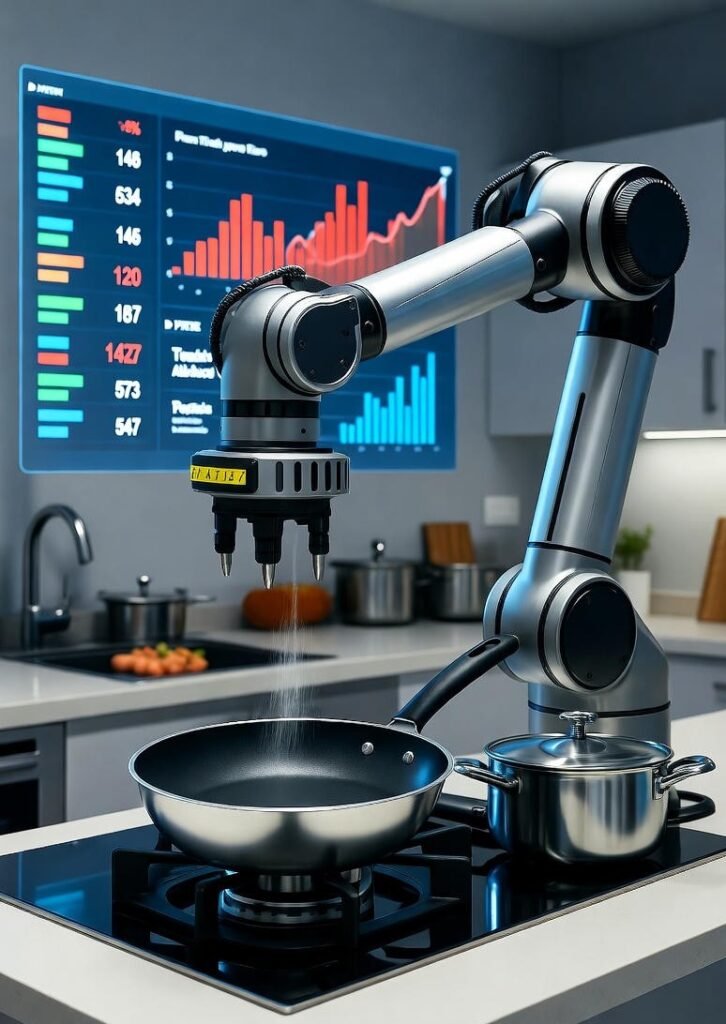
Key Takeaway: Researchers at MIT have built “virtual kitchens”—high-fidelity simulation environments where robots can practice manipulating utensils, recognizing textures, and reasoning about everyday tasks. The platform shortens the path from simulation to reality, accelerating the development of robot foundation models that can generalize across spaces and tools.

Why Virtual Environments Matter
Training robots in the physical world is slow and expensive. Every grasp, failure, and crash costs time and hardware. By moving early learning into photorealistic digital kitchens, MIT’s Computer Science and AI Laboratory (CSAIL) lets robots accumulate millions of practice episodes per day—orders of magnitude more than possible in physical labs.
The result: robots that enter real-world kitchens already understanding spatial layouts, material interactions, and basic task sequences like “pick-pour-stir.”
Inside the Simulation Stack
- Physics Engine Upgrade: A custom Bullet-based engine models viscosity, heat transfer, and liquid dynamics for realistic cooking tasks.
- Material Library: 3 000+ objects (textured bowls, pans, cutlery, foods) with friction and elastic properties for tactile accuracy.
- Vision-Language Integration: Robots learn from annotated recipes and natural-language commands—bridging text and action.
- Embodied Foundation Models: Large transformer architectures encode sensor streams so policies generalize across tasks.
The kitchens run on distributed GPU clusters, generating synthetic datasets that train multi-modal agents capable of reasoning about cause and effect—“if the pan is hot, don’t grasp it bare-handed.”
From Cooking to General Manipulation
While the demo scenario is culinary, the applications span manufacturing, eldercare, and lab automation. Skills like stirring, pouring, and cutting map to industrial assembly and medical pipetting. MIT’s simulations are already being used by robot companies to pre-train policies before real-world deployment, reducing calibration time by up to 60 %.
Industry and Academic Collaboration
The project is open-sourced through the Robotics Learning Foundation and linked to NVIDIA Isaac Sim and OpenAI Gym interfaces. Partners include Toyota Research Institute, Boston Dynamics AI Institute, and Amazon Robotics—each contributing datasets and benchmark tasks. This collaboration creates a shared metric for robotic generalization, analogous to ImageNet for vision models.
Teaching Robots Through Language and Imitation
Using paired recipe instructions and human motion-capture, MIT’s system builds “action graphs” linking verbs to motions. A command like “slice the apple and place it in the bowl” becomes a multi-step plan that the robot can execute in sim and transfer to real hardware via domain-adaptation networks. This fusion of vision, language, and motor control defines the next frontier of embodied AI.
Impact on Embodied AI Research
Virtual Kitchens help close the “reality gap” that has long plagued robotics — where agents that perform well in sim fail in the real world. By combining accurate physics with domain randomization and continual learning, MIT researchers report a 40 % increase in transfer success to physical robots. This accelerates progress toward general-purpose robots that can adapt on the fly.
What’s Next
Future iterations will incorporate multi-agent collaboration (robots working together in shared kitchens) and simulate human-robot interaction for co-cooking tasks. The vision: a platform where millions of virtual agents train concurrently on cloud GPUs, sharing skills through federated learning to accelerate real-world deployment.
The Bottom Line
MIT’s Virtual Kitchens project is a microcosm of AI’s embodied future — where robots don’t just see the world but learn to act within it. By compressing years of trial and error into simulated hours, MIT is turning robotics training into a software problem — and in doing so, redefining what it means to teach a machine to learn from experience.
About Timeless Quantity: Your daily lens on AI, space, and the digital future. Subscribe for deep dives and research explainers.