Google’s “Quantum Echoes” Breakthrough: What 13,000× Speedups Mean for Useful Quantum Computing
Published on: 2025-10-22 • Category: Quantum • By Timeless Quantity
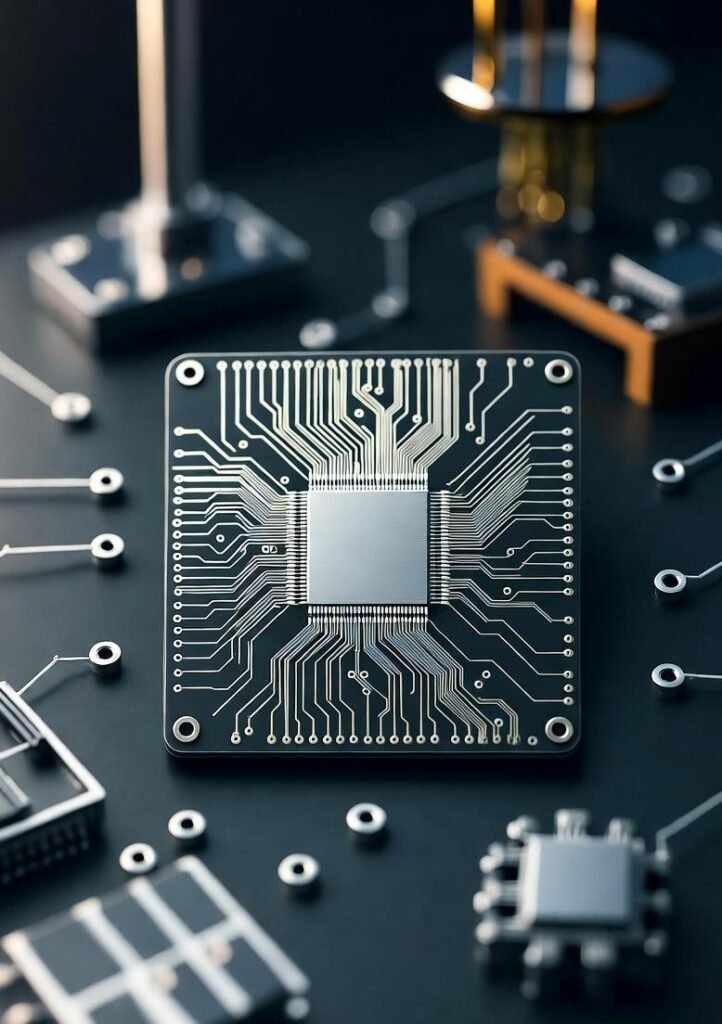
Google’s quantum research team has announced a striking milestone: a “Quantum Echoes” algorithm running on the Willow processor that reportedly beats the best classical supercomputers by as much as 13,000× on a targeted task. While quantum advantage claims have surfaced before, the latest result is notable for the scope of the experiment, the error-mitigation methods employed, and the suggestion that we’re inching closer to useful quantum regimes—areas where quantum hardware produces results that are both faster and hard for classical machines to replicate.
In this explainer, we unpack what Quantum Echoes is, why Willow matters, how to think about the 13,000× figure, and where this sits on the long road from lab demonstrations to industry-relevant applications.
What Is “Quantum Echoes”?
Quantum Echoes is a family of circuits designed to stress specific properties of a quantum processor—entanglement generation, circuit depth tolerance, and coherence management—while producing outputs amenable to statistical verification. In practice, Echoes runs sequences of randomized gates (or structured patterns), then “echoes” or partially inverts those sequences to analyze how information disperses and refocuses across qubits. The design makes it harder for classical simulators to track the full state space as qubit counts and circuit depths rise.
Think of Echoes as a benchmark-style algorithm with knobs for size and difficulty. It doesn’t solve a business problem by itself, but it does test behaviors fundamental to many emerging quantum workloads: scrambling dynamics relevant to chemistry simulation, randomized compiling for noise resilience, and correlational patterns used in error mitigation.
Inside Willow: Why This Chip Matters
Willow is part of Google’s superconducting qubit line—an architectural path that pairs microwave control with cryogenic environments to achieve low-error gates. Key features that likely contributed to the Echoes result include:
- Improved 2-qubit fidelities: Higher-quality entangling gates enable deeper circuits before noise washes out the signal.
- Better connectivity and layout: Routing multi-qubit interactions efficiently reduces overhead for complex circuits.
- Stability for long runs: Hardware-software orchestration (calibration, drift tracking, active compensation) is crucial for repeatable results.
Progress at the hardware layer compounds with better compilers, smarter transpilation, and error mitigation—techniques that algorithmically counteract noise without a full error-correcting code. Willow appears to benefit from a pipeline that co-optimizes all of the above.
About That 13,000× Speedup
Speedup claims in quantum computing often spark debate. Here’s a pragmatic way to read the 13,000× figure:
- Task-specific advantage: The Echoes circuits are chosen to be genuinely hard for classical simulation, especially at larger sizes/depths. The speedup does not mean quantum will be 13,000× faster at every workload.
- Scaling pressure on classical: Classical simulators excel at small to medium circuit sizes. But as the qubit count and entanglement grow, classical runtime and memory needs explode. The experiment probes that regime.
- Verification remains tractable: Clever statistical checks and cross-entropy/echo metrics help ensure the quantum outputs are not random noise.
In short, 13,000× is a signal that we’re breaching classical comfort zones on structured problems—not a blanket statement that quantum has “won.”
From Milestones to Usefulness
What would it take to convert Echoes-style wins into production value?
- Error correction maturation: Today’s results rely on error mitigation. The big leap will come from logical qubits protected by error-correcting codes, unlocking deeper circuits with reliability measured in hours or days, not milliseconds.
- Domain-tuned algorithms: Chemistry (molecular energies, catalysis), materials (superconductors, battery compounds), finance (risk, portfolio sampling), and optimization (scheduling, routing) all have candidate formulations that benefit from quantum subroutines.
- Hybrid quantum-classical orchestration: Expect pipelines where classical HPC handles outer loops (optimization, gradient estimation) while quantum accelerators compute hard inner kernels.
- Benchmark standardization: The industry needs “SPEC-like” suites for quantum so results are comparable across labs, chips, and software stacks.
Echoes shows the hardware-software stack is maturing. Usefulness will come as these demonstrations are translated into domain-specific workflows with clear accuracy or cost advantages.
The Competitive and Research Landscape
Google’s announcement doesn’t exist in a vacuum. IBM, IonQ, Quantinuum, Rigetti, and several national labs are pushing hard on fidelity, connectivity, and early error correction. On the software side, open-source frameworks and cloud platforms are making it easier for researchers to prototype algorithms and run them on real hardware. The result is a healthy cycle: hardware advances enable deeper circuits; software and algorithms evolve to exploit them; empirical results inform next-gen chip design.
For enterprises, the best strategy remains learn-by-doing: establish small quantum teams, build proof-of-concepts in chemistry or optimization, and maintain a watchlist of hardware milestones that would justify scaling investment. Echoes-style breakthroughs are precisely the signals such watchlists should track.
Caveats, Risks, and How to Read Headlines
- Benchmark bias: A result that is hard for classical simulation today may yield to a new classical algorithm tomorrow. Advantage is a moving target.
- Noise ceilings: Without full error correction, circuit depth is still bounded. Error mitigation helps but cannot substitute indefinitely.
- Economic relevance: Speedups on synthetic tasks must translate to value on real problems—accuracy, throughput, or cost reductions.
- Reproducibility: Independent replication and peer-reviewed details will fortify claims and refine our understanding of where the advantage truly lies.
Signals to Watch Next
- Logical qubit demos: Multi-logical-qubit experiments performing non-trivial algorithms with sustained coherence.
- Echoes to chemistry: Porting Echoes-like circuit capabilities into variational chemistry or Hamiltonian simulation benchmarks.
- Cross-vendor results: Comparable experiments on other platforms (trapped ions, neutral atoms) to triangulate hardware trade-offs.
- Hybrid workflows: Case studies where a quantum inner loop materially reduces total runtime vs. HPC-only approaches.
The Bottom Line
Google’s Quantum Echoes result on Willow is another step toward useful quantum computing. It demonstrates that carefully chosen circuits at meaningful scale can outrun classical techniques by large margins. The key now is conversion: translating experimental advantage into domain workflows with measurable business impact. For leaders tracking the field, the message is clear—quantum isn’t a solved problem, but the window for building expertise before utility arrives is narrowing.
About Timeless Quantity: Your daily lens on AI, space, and the digital future. Subscribe for deep dives, data-driven explainers, and hands-on guides.