Google has never shied away from moonshots, but Project Suncatcher is literally beyond the moonshot metaphor.
Announced quietly through research papers and partner disclosures, Suncatcher proposes AI data centers operating in low-Earth orbit, fueled by perpetual solar power and communicating through laser-based optical links.
The initiative arrives at a critical moment: AI’s rapid growth is colliding with Earth’s energy limits.
Every new model — GPT-5, Gemini Ultra, Claude Next — multiplies demand for electricity, water, and cooling. Traditional data centers already consume an estimated 3 % of global power. If nothing changes, that figure could double by 2030.
Suncatcher could rewrite that equation.

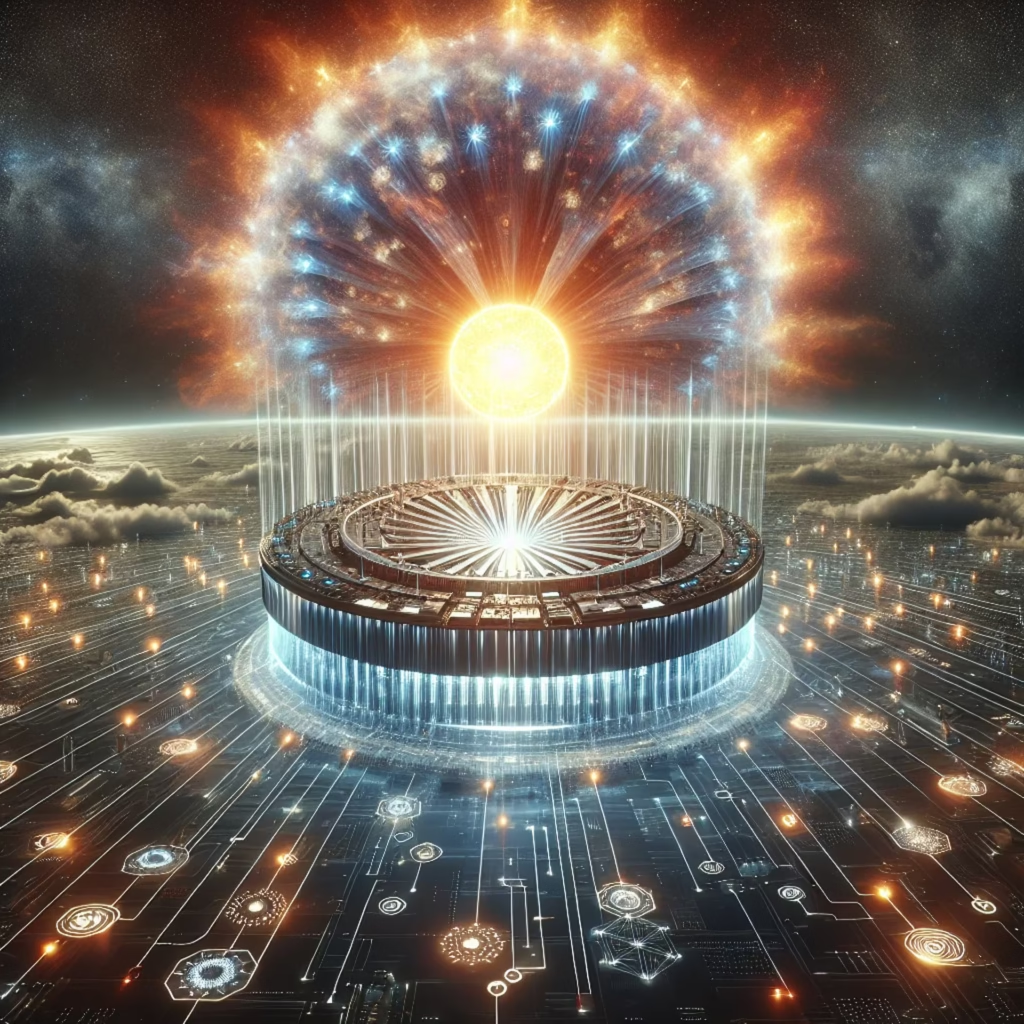
☀️ Why Space Makes Sense for AI
1️⃣ Unlimited Energy:
Orbiting satellites in a sun-synchronous path receive nearly continuous sunlight (>95 % uptime). No night cycles mean near-constant solar harvesting — something impossible on Earth.
2️⃣ Natural Cooling:
In microgravity, radiative cooling becomes simpler. Components can dissipate heat without elaborate HVAC systems.
3️⃣ No Land or Water Use:
Each terrestrial data-center requires acres of land and millions of liters of cooling water yearly. In space, both requirements vanish.
4️⃣ Scalability and Redundancy:
Dozens — eventually hundreds — of compute satellites could act as a distributed orbital cloud, seamlessly balancing global demand.
🧠 Engineering the Impossible — How It Works
- Solar Arrays: Giant photovoltaic wings feed power directly into AI compute modules.
- Processing Units: Custom Tensor Processing Units (TPUs) adapted for radiation resistance and thermal extremes.
- Laser Links: Free-space optical communication enables up to terabits per second of throughput between satellites.
- Downlinks: Ground stations beam encrypted data to Google Cloud regions on Earth.
This constellation could, in theory, process massive model-training workloads in orbit, while Earth facilities handle inference and delivery.
🔬 The Partners Powering Suncatcher
Google isn’t alone.
- Planet Labs will provide satellite-bus engineering and launch integration.
- NVIDIA is developing space-qualified Grace Hopper chips for orbital compute clusters.
- Alphabet X is coordinating research with universities for optical-link testing.
Their combined ecosystem mirrors SpaceX + Starlink’s architecture — but optimized for data rather than internet.
⚙️ Sustainability Meets Scalability
AI today is both a miracle and an environmental challenge.
Training GPT-4 reportedly consumed ~700 MWh of electricity — equivalent to powering ~60 U.S. homes for a year.
Multiply that by thousands of models, and Earth’s grids strain.
By contrast, one Suncatcher cluster (81 satellites) could offset an entire hyperscale center’s annual emissions. Google’s internal estimates suggest an 80 % reduction in CO₂ once scaled.
💰 Economic and Geopolitical Ripple Effects
- Investment Boom: VCs are labeling this the birth of a new market: Orbital Compute Infrastructure (OCI).
- Regulatory Race: Expect new treaties defining data sovereignty above Earth.
- Competition: Microsoft, Amazon, and Alibaba have begun patent filings for orbital server designs.
- National Security: Governments eye dual-use benefits — AI satellites could assist in climate monitoring and defense AI.
⚠️ The Challenges Ahead
- Launch Economics: Although reusable rockets have dropped cost < $200/kg, a 100-satellite array still costs > $500 million.
- Radiation Hardening: AI chips must survive cosmic rays and temperature swings (–150 °C to +120 °C).
- Latency & Reliability: Despite laser speed, cloud workloads sensitive to milliseconds may struggle.
- Space Debris: Orbital pollution threatens both sustainability and public perception.
🌍 Environmental and Ethical Implications
Supporters frame Suncatcher as green AI; critics warn of space colonialism.
Key questions:
- Who owns data processed in orbit?
- What happens to decommissioned satellites?
- Could AI systems operating autonomously in space pose new cyber-security risks?
Google pledges full transparency via a “Space Data Ethics Board” — the first of its kind.
🧩 Broader AI Ecosystem Connections
Suncatcher could complement Earth-based sustainability pushes:
- Microsoft’s OceanCool Project (sub-sea data centers).
- Amazon’s Hydrogen Server Farms.
- NVIDIA’s Modular AI Pods for renewable regions.
Together, these signal the dawn of an era where compute follows energy — not the other way around.