Introduction – When AI Moves From Prototype to Proof
2025 marks a turning point where artificial intelligence stopped being an experiment and started becoming infrastructure.
Akkodis’s latest report, released through PR Newswire, captures this shift with hard data: AI isn’t just producing insights—it’s transforming logistics, healthcare, energy, and engineering operations at industrial scale.
Behind the headline metrics lies something deeper: the rise of applied intelligence — AI that doesn’t just predict the future, but actively builds it.
From Innovation to Implementation
Akkodis, a fusion of Modis Engineering and AKKA Technologies, positions itself at the crossroads of engineering and digital transformation.
Its 2025 report highlights that over 70 % of its enterprise clients now integrate AI in daily workflows — from autonomous design validation to energy-grid optimization.
This signals a maturity phase in the AI economy:
- 2015 → Hype: AI as concept and demo.
- 2020 → Deployment: AI as cloud service.
- 2025 → Integration: AI as unseen operating layer across industries.
Akkodis isn’t selling technology; it’s selling transformation — proof that AI’s return on investment arrives when data meets domain expertise.
Engineering the New Intelligence Stack
The report breaks down Akkodis’s AI stack into three tiers:
- Perception AI – Computer-vision and sensor-fusion models that monitor industrial environments.
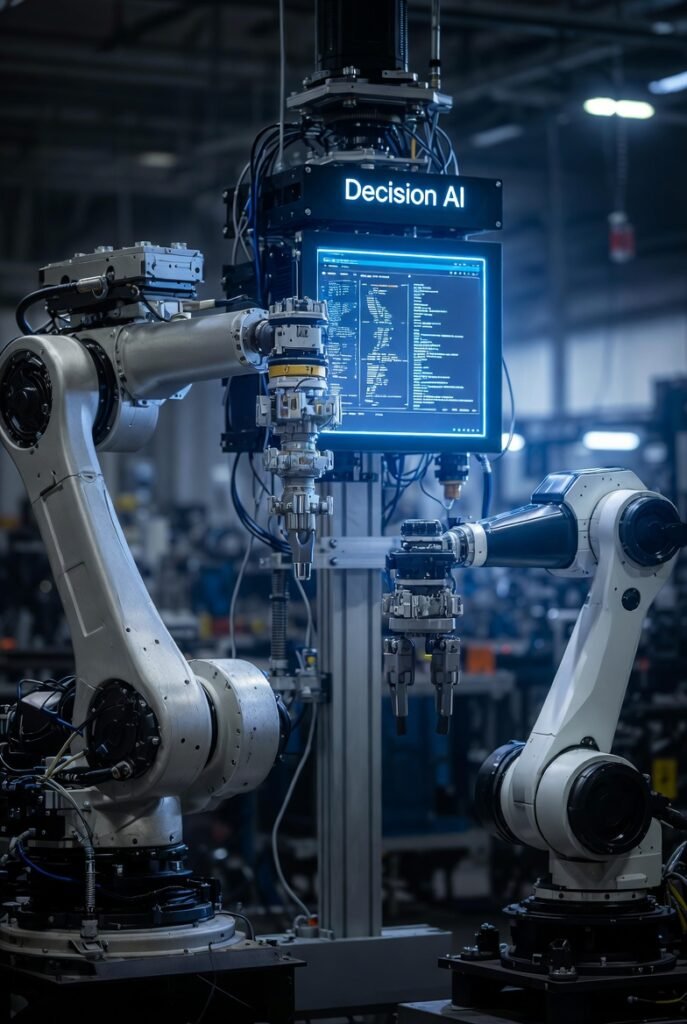
- Decision AI – Predictive and prescriptive analytics optimizing real-time operations.
- Generative AI – LLMs and simulation agents that design, document, and prototype autonomously.
In manufacturing, for instance, generative models co-create component blueprints with human engineers.
In energy, reinforcement learning algorithms forecast demand and adjust turbine loads, saving megawatts hourly.
Each tier loops data back into a continuous learning cycle—Akkodis calls it “the perpetual feedback factory.”
Sector Impact – AI Across Industries
Healthcare and Life Sciences
AI-driven imaging analysis has cut diagnostic time for cardiac anomalies by 40 %.
Digital twins simulate patient responses to treatment before dosage, reducing trial costs.
Akkodis engineers describe this as precision medicine meeting predictive maintenance logic.
Automotive and Mobility
Predictive analytics inside connected vehicles anticipate component failure long before breakdowns.
This turns maintenance from reactive expense into data asset — what Akkodis calls “the service economy of motion.”
Energy and Utilities
AI monitors wind farm efficiency in real time, balancing output against weather volatility.
Early pilots report 7 – 10 % uptime improvements — a massive gain for renewables.
Industrial Design and Engineering
Generative design tools explore thousands of architectural variations per minute, filtering by sustainability metrics rather than just cost.
The result: lighter structures, shorter supply chains, and smaller carbon footprints.
The Hidden Layer of AI – Augmented Workforce
Contrary to fears of job erosion, Akkodis’s data suggests AI is expanding human capacity.
Engineers now spend less than 30 % of their time on repetitive tasks, redirecting focus toward creativity and strategic design.
This echoes a broader theme within Timeless Quantity analysis: the future of work isn’t replacement — it’s redistribution of intellect.
AI handles volume; humans handle vision.
The companies that recognize this division first become the next decade’s winners.
Metrics That Matter
Akkodis reports:
- 22 % average productivity gain across client projects within 12 months.
- 18 % reduction in carbon emissions through AI-based efficiency models.
- 35 % increase in speed-to-prototype for engineering design cycles.
These aren’t hypothetical figures; they’re evidence that AI value compounds over time when models learn from operational data.
Why Akkodis Matters in the AI Ecosystem
While Silicon Valley builds algorithms, Akkodis builds applications.
It represents a quiet shift from software-first to solution-first philosophy.
This positioning gives Europe a distinctive voice in the AI race — one focused on human-centric engineering and ethical scaling.
The company’s cross-industry presence makes it a barometer for AI integration worldwide.
As APAC and North America chase speed, Akkodis balances it with stability — turning AI into a long-term competitive infrastructure rather than a short-term trend.
Ethics, Explainability & Trust
Akkodis frames its AI strategy around three pillars:
- Transparency: Every model’s decision path must be explainable to non-technical stakeholders.
- Security: Edge-AI deployments encrypt data locally, minimizing cloud exposure.
- Sustainability: AI workloads are mapped to low-carbon data-centers.
This approach aligns with EU AI Act principles and positions Akkodis as a model for “responsible scaling.”
The Investor’s View
In 2025’s volatile AI market, Akkodis represents measured maturity.
While startups chase valuation spikes, Akkodis anchors value in infrastructure contracts and energy efficiency — a defensive but lucrative position as the AI bubble debate intensifies.
Analysts see this as the “industrialization phase of AI” — less about novelty, more about scale and stability.
Conclusion – AI as Applied Evolution
Akkodis’s AI-led innovation demonstrates that the age of experiments is over.
What matters now is execution at the intersection of engineering, ethics, and energy.
AI is no longer a destination — it’s a direction of travel.
In that sense, Akkodis is not just an AI company; it’s a symbol of how intelligence — human and synthetic — can co-engineer a more sustainable, profitable future.