Industry now builds 90% of major AI models — the future of intelligence is corporate.
🧠 The World Just Crossed a Tipping Point
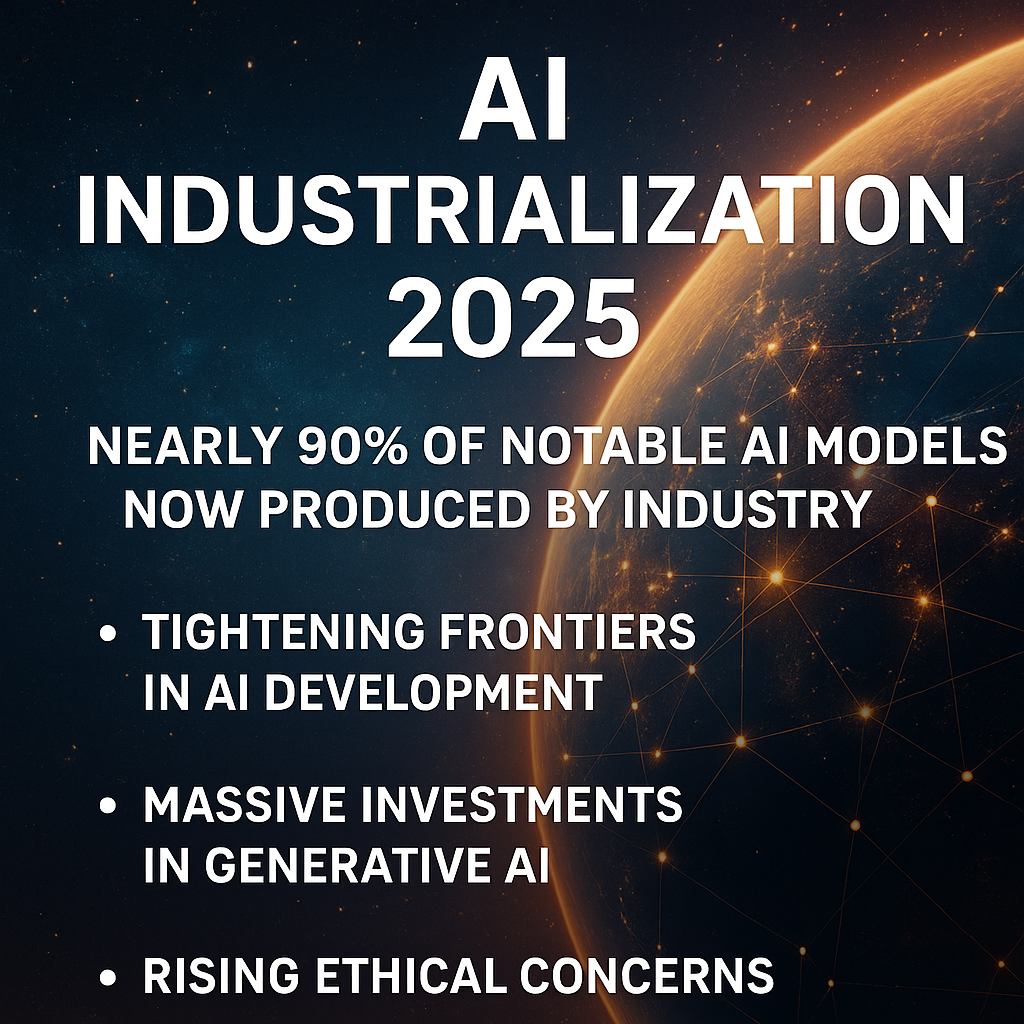
The 2025 Stanford AI Index Report just dropped — and it’s a wake-up call.
For the first time in history, industry players now produce nearly 90% of all major AI models, up from just 60% two years ago.
That means the future of artificial intelligence is being built behind closed doors, not in university labs.
As AI becomes the most valuable resource since oil, power is shifting — not just in technology, but in economics, policy, and even identity.
In short: AI isn’t just evolving. It’s industrializing.
⚙️ The Great Shift: From Open Labs to Private Fortresses
The early days of AI were open and collaborative. Universities like Stanford, MIT, and Oxford shared papers, code, and benchmarks freely. But in 2025, that landscape looks entirely different.
The report shows that massive compute costs, proprietary datasets, and strategic talent hoarding have pulled innovation into corporate hands.
Tech giants and emerging startups are locking down data and models to maintain competitive advantage — creating what some researchers call “The AI Frontier Gap.”
“Frontiers are tightening — and innovation is clustering around capital, not curiosity.”
— Stanford AI Index 2025
It’s not just about who builds models. It’s about who controls the infrastructure, the data pipelines, and the narratives shaping our digital future.
🤖 The Rise of Agentic & Physical AI
The report highlights two massive 2025 trends that are already reshaping industries:
1. Agentic AI
Think of AI systems that don’t just respond — they act.
Agentic AI refers to autonomous systems capable of reasoning, planning, and executing complex multi-step tasks without human input.
From customer support bots that handle full workflows to AI “employees” managing spreadsheets, ads, or content pipelines — this is the next big leap.
2. Physical AI
Meanwhile, robotics is merging with neural intelligence.
Startups like Figure AI, Tesla, Sanctuary AI, and Agility Robotics are building humanoids that learn from data — creating “Physical AI” systems that can see, move, and adapt like humans.
These two branches — Agentic and Physical AI — are blending.
Together, they’re redefining what “intelligence” means in the real world.
⚖️ The Ethical and Economic Frontiers
With power concentrating in private hands, new challenges emerge.
Data Privacy & Bias
The more data companies collect, the higher the risk of breaches and misuse.
Training data now spans everything from personal emails to social media posts — raising questions about consent and fairness.
Job Displacement
McKinsey’s 2025 Tech Outlook predicts that AI could automate up to 30% of repetitive white-collar work by 2030.
While productivity will soar, millions of workers may need reskilling to stay relevant.
Ethical Design
Governments are still catching up.
As AI becomes more autonomous, we face a moral question: Who’s responsible when machines make decisions?
“The next decade will be defined by how we balance power, privacy, and progress.”
— McKinsey Tech Outlook 2025
💸 The Money Behind the Machines
Let’s talk numbers.
- AI Market Growth: 31.5% CAGR (2024–2030) — faster than any other tech sector.
- Corporate Investment: Tens of billions flowing into generative AI, robotics, and cloud infrastructure.
- Nvidia’s Rise: Pushing a $5 trillion valuation as demand for AI GPUs and data centers explodes.
- Quantum & Cloud: The race for AI compute supremacy is fueling new energy and data architectures.
In short, the new gold rush isn’t in code — it’s in compute.
If you want to predict the next trillion-dollar companies, don’t look at apps — look at who controls the servers, chips, and algorithms that power them.
🔮 What This Means for You
1. For Tech Professionals
This is your decade to evolve.
Upskill fast in AI infrastructure, data ethics, model operations (MLOps), and autonomous systems.
Understanding how AI agents make decisions will be as important as coding itself.
2. For Businesses
Start integrating AI copilots, workflow agents, and analytics automation.
The productivity frontier is here — companies that adapt now will outperform competitors by wide margins.
3. For Everyone Else
Prepare for coexistence, not competition.
The future workforce will be hybrid — human creativity paired with machine intelligence.
The best investment you can make isn’t in AI stocks — it’s in learning how to use AI well.
🌐 Why This Moment Matters
The timing of this report couldn’t be more electric.
McKinsey’s outlook on human-machine collaboration, Stanford’s findings on AI concentration, and the viral debates on AGI ethics and infrastructure are all converging.
On X, threads about “State Space Models”, “Autonomous Agents”, and “AGI regulation” are exploding with thousands of engagements daily.
This is the inflection point — where academic curiosity meets corporate capital.
If history is any guide, the next five years will define who leads (and who gets left behind) in the intelligent economy.
📢 Final Take: The Future Is Industrialized Intelligence
AI is no longer a field — it’s an ecosystem of economies, ethics, and ecosystems evolving faster than policy can catch up.
The Stanford AI Index 2025 doesn’t just show data — it reveals destiny.
And the message is clear:
The future of intelligence belongs to those who build, not just those who study it.
🔗 Share & Spark Discussion