A Ghost Particle Illuminates the Heart of the Sun
Deep beneath the Earth’s surface, shielded from cosmic noise and background radiation, scientists have observed something extraordinary: a rare solar neutrino triggering a direct atomic transformation. This elusive event, detected inside the SNO+ detector, confirms long-standing predictions about how the Sun generates its immense energy—and how neutrinos behave along the way.
Neutrinos are often called ghost particles. They pass through planets, stars, and human bodies by the trillions every second without leaving a trace. Catching one in the act of altering an атом is like photographing a single snowflake inside a blizzard—while blindfolded.
Yet that is precisely what researchers have now achieved.
What Exactly Was Observed?
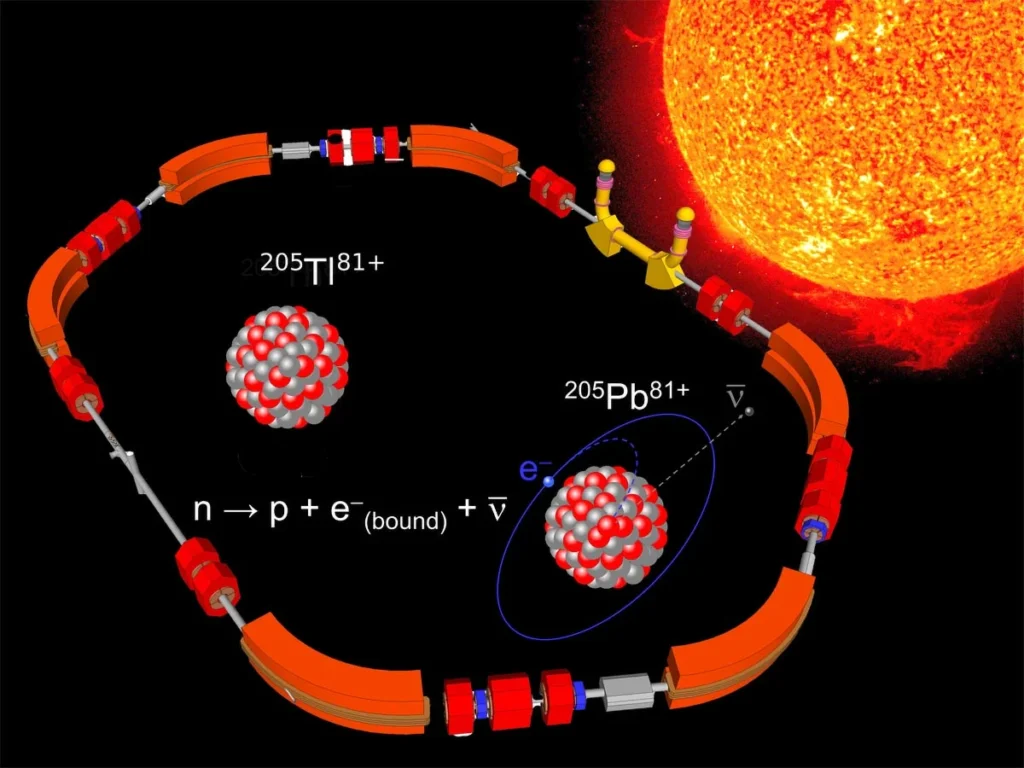
The breakthrough involves a rare reaction in which a solar neutrino interacts with carbon-13, transforming it into nitrogen-13. This process had been theorized for decades but had never been directly observed.
This transformation confirms a subtle part of the CNO (carbon–nitrogen–oxygen) fusion cycle, one of the processes powering the Sun. While most solar energy comes from hydrogen fusion, the CNO cycle plays a crucial role in heavier stars and contributes a smaller but essential fraction of the Sun’s output.
Until now, evidence for this process was indirect.
This observation changes that.
Why Neutrinos Matter So Much
Neutrinos are unique messengers. Unlike light, which can take thousands of years to escape the Sun’s dense interior, neutrinos travel almost instantly from the core to Earth.
That makes them the only direct probes of ongoing fusion reactions happening right now inside the Sun.
By observing neutrinos, scientists are not reconstructing history—they are watching stellar physics in real time.
This particular detection validates models of:
- Solar energy production
- Particle interaction probabilities
- Neutrino flavor oscillations
Each confirmation tightens our understanding of both astrophysics and fundamental particle physics.
Inside the SNO+ Detector
The SNO+ detector is located deep underground in Canada, inside a former nickel mine. It uses an enormous tank filled with ultra-pure liquid scintillator, surrounded by thousands of sensitive light detectors.
When a neutrino interacts with an atom inside the detector, it produces a faint flash of light—just enough to be recorded.
The depth is crucial. Being underground filters out cosmic rays and background interference, allowing researchers to isolate incredibly rare events.
Detecting this transformation required:
- Years of data collection
- Extreme material purity
- Sophisticated noise filtering algorithms
This was not luck. It was precision.
Why This Discovery Matters Beyond Astronomy
This finding ripples far beyond solar science.
In particle physics, it provides a new testing ground for neutrino behavior and weak nuclear interactions.
In cosmology, it sharpens models of stellar evolution, particularly for massive stars where the CNO cycle dominates.
In experimental physics, it demonstrates that detectors are now sensitive enough to capture interactions once thought practically invisible.
Each improvement builds momentum toward answering deeper questions:
- Why neutrinos have mass
- How matter dominates over antimatter
- Whether unknown physics lies beyond the Standard Model
A Quiet but Profound Milestone
This discovery did not arrive with explosions or headlines of cosmic catastrophe. Instead, it emerged quietly—from a detector listening patiently for whispers from the Sun.
That is often how science advances.
Not with spectacle, but with certainty.
By confirming this rare neutrino interaction, scientists have added a new, solid brick to the foundation of modern physics—one placed deep underground, yet illuminating the core of a star 93 million miles away.